
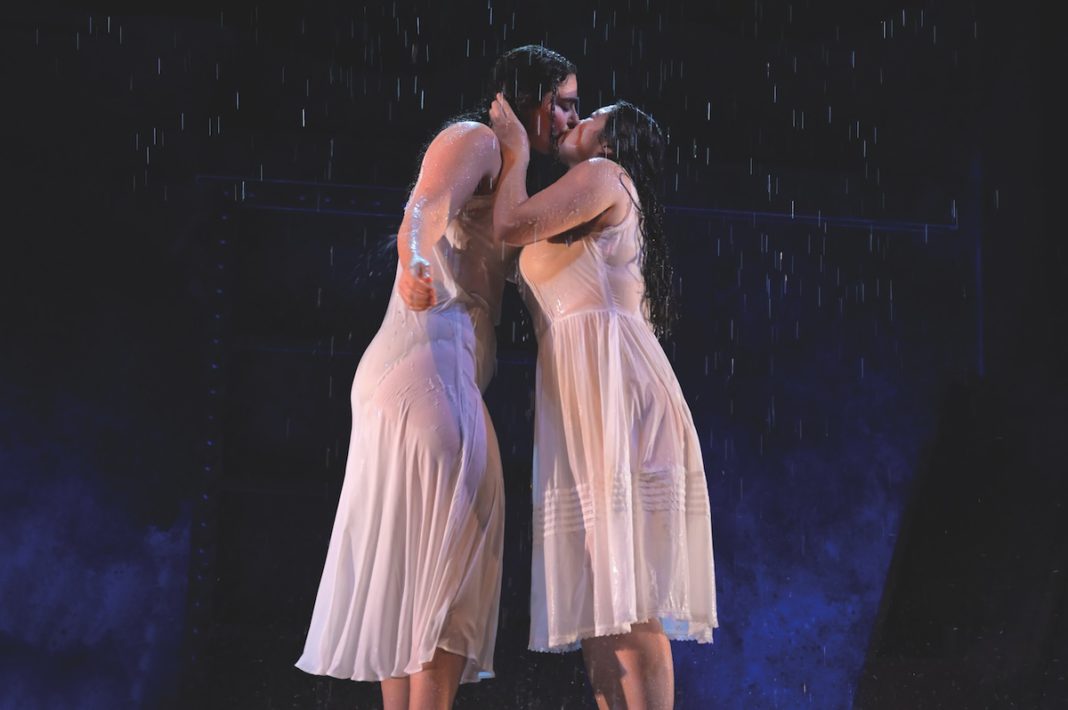
Center REP launched its 58th season Sept. 7 with Pulitzer Prize-winning playwright Paula Vogel’s play, Indecent. Running through Sept. 28 at Walnut Creek’s Lesher Center for the Arts and presented in partnership with Yiddish Theatre Ensemble (YTC), the production is anchored in the true story of Polish dramatist Sholem Asch.
His 1906 play, God of Vengeance, successfully toured in Europe. But after it premiered in America in 1923—it included the first queer kiss on Broadway—the cast and director were charged with obscenity and jailed. The freedom to speak of and act upon queer identity was curtailed and condemned.
Which makes Vogel’s play-within-a-play relevant to audiences in 2025. After all, daily life often feels scripted or like an act. Be it a reality TV star occupying the Oval Office, social media’s “fake news” proliferation or the AI invasion, authenticity appears to have flown the coup.
The Yiddish Theatre Ensemble’s co-artistic directors, Laura Sheppard and Bruce Bierman, first presented Bay Area audiences with an online, English version of Asch’s The God of Vengeance in 2021. One year later, a collaboration with San Francisco Playhouse brought the work to local stages. Center REP breathes new life into Indecent under the direction of Elizabeth Carter, along with a seven-member cast and three musicians.
Carter says her first interest in the play was the ghost troupe that is integral to the storytelling. “I love ghosts,” she said. “I love things that always have been and always will be; a continuum of time from past to future. I call that an Afro-surrealist view with all things happening simultaneously. Potentially, our future is here, now. The second thing is the idea that a language and culture can disappear.”
Carter is not Jewish, and is both Black and queer. She said the play also speaks to interrogating oneself versus being interrogated, of a culture facing possible extinction. When any community shocks people by straying outside of societal “norms”—in this play, a tender romance between two young girls—labels are applied.
“Instead of embracing the richness of humanity,” Carter said, “we shut it down, try to control the narrative of how we and our culture are seen. That makes people feel comfortable, but it’s usually a narrow window.”
Carter was struck by the way Vogel breaks form. “It’s not a simple, chronological story,” she said. “We’re going back in time, but we’re interspersing it with present-day theater. It’s looping the past with where we are right now; a world of censorship, queer folks and trans rights being on the chopping block, immigrants being removed, an authoritarian state and dare I say, fascism. This is happening to people from 1905 to 1950 and mirrors the present environment.”
The ghost troupe had to be steeped in Jewish mysticism; the actors had to command the play’s immediacy while dancing, singing and telling stories in Yiddish. “[The script] asks a lot of them,” Carter said. “When speaking in English they have to speak with Yiddish, German and Lithuanian accents.”
Carter wants audiences leaving the theater to recognize the diasporic Jewish community and to ask themselves, “How can we let travesties like this happen again?”
In research conducted with YTC’s directors, she explored gaps in her lived-in knowledge base: German Expressionist dramaturgy, Yiddish movies and art, and more. “They gave me so much juice,” she said. “They connected me with a scholar who translated Asch’s play, sat in on run-throughs, gave actors feedback.”
Aware of the devastating “oh no, this is where we are” blow the play might make, she said there’s also hope in the way people never give up on things like the story at its center. “It’s a love story for these two girls, a love story for theater,” she said. “That gives us the hope that we can make real what we believe in our hearts to be true. In the depth of despair, there’s resistance and the idea that we can get to joy, freedom, a better ending.”
She said that, despite the reality of oppositional forces, “We just have to not cave. We have to do uplifting plays, but also plays that hold the edge and continue to have people questioning their hearts and minds to find imaginative answers in times of darkness and discomfort.”