
East Bayers are implementing their own contingency plans as the Trump administration reluctantly agrees to issue half the Supplemental Nutrition Assistance Program (SNAP) benefits for its 42 million recipients on a delayed schedule. Residents are scaling back, going without and leaning on each other.
Maribel Flores lives in Concord with her three daughters. Since her brother got deported last month, Flores and her 65-year-old mother now also care for her brother’s children.
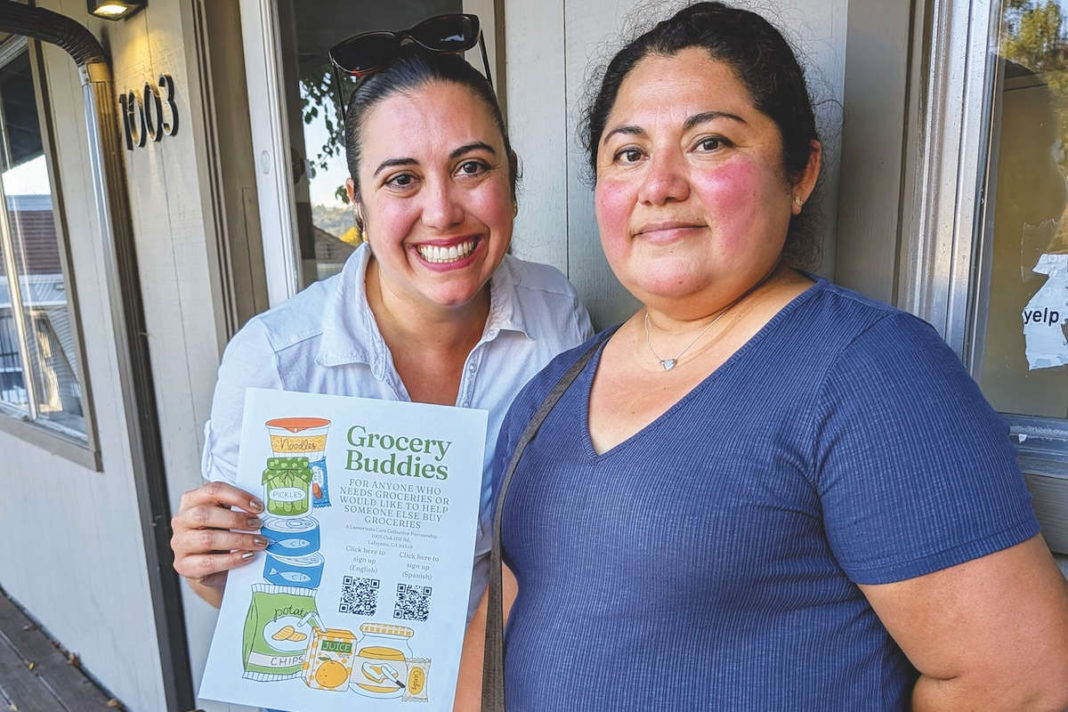
“I gave up my food stamps a few years ago and started going to the food bank instead,” Flores said as she signed up for a grocery buddies program. Flores’ mother struggles with diabetes, and her daughter has autism. “I have medical insurance, but everything is expensive,” she said. “I’m very shy about asking for help, but today I’m surprised and happy to get some.”
Elizabeth Berkes, from Moraga, is part of a collective of women from her church who are creating a system in which folks in need sign up for a grocery shopping buddy to help keep food on tables. Berkes set up a table outside of the Lamorinda Care Collective free store in Lafayette with a Google Form and Google Translate ready, as people from both sides of the Caldecott Tunnel signed up to either receive or offer help.
“It’s so frustrating that the government isn’t willing to take care of its citizens,” Berkes said. “The only blessing is that we get to step in and meet our neighbors.”
As a single mom and a preschool teacher, Sunita Shastri is used to being frugal. Shastri lives in an apartment with her boys and an unrelated roommate. She cooks at home and considers it a blessing that she’s always been able to use her EBT card (SNAP) at the local Indian store to keep all the staples on hand. Over the weekend Shastri spoke with her children.
“I explained to my kids that we’re scaling back. No meat or fish. Just the basic things like fruit, onions and tomatoes,” Shastri said. “We’ll have lentil soup and rice, and maybe an egg once in a while for a treat.”
Before Shastri had SNAP benefits which now afford her a monthly food allowance of around $300, she remembers finding it hard to buy anything other than rice and lentils. “The dahl and lentils that I have in my pantry will suffice for about 3-4 months. I’ve budgeted $20 a month for fruit,” Shastri said. “It’s sad to tell my kids that they can’t eat what they want or that they can’t cook because we don’t have enough food.”
Matt Harrison is the executive director of the Community Youth Center (CYC) in Concord, a place that serves 2,100 youth between the ages of 3 and 18—the majority of whom come from low-income families.
“As financial stress and food stress comes into a household, it has a ripple effect. When there’s anxiety, stress and fear, and no certainty for the future, it creates a dangerous home environment,” Harrison said. “If you’re worried about your next meal, then homework isn’t important and your academic future starts to fall away. Then the cycle repeats itself, and this is how we end up in a cycle of poverty.”
While food insecurity is a real issue for families of CYC members including some who utilize SNAP benefits, Harrison says others go without—particularly immigrant families.
“If I’m scared or living in fear of being deported or having a loved one get deported, I’m not seeking help,” Harrison said.
Harrison says it’s more important than ever for Americans to commune with one another. The CYC is offering Thanksgiving meals to the families of its youth members. It also offers resource fairs with partners such as Monument Crisis Center, Welcome Home Baby, Making Waves Education Foundation and Northern California Family Center.
“We’re leaning heavily into the community part of our name,” Harrison said. “It’s the only thing that gets us through the divisiveness in our country. We need to stop blaming and yelling, and start having dialogue. We need to understand that our political perspectives are different because our lives are different.”