
Let me get the hype out of the way: One Battle After Another isn’t simply just an instant classic—which it is. Neither is it just another great Paul Thomas Anderson movie. What One Battle After Another actually achieves is something even more singular: It’s a film released at a perfect time that feels like a manifesto, a state of the union address and a canary in a coal mine, all in one.
But since Anderson is a master filmmaker incapable of making art that doesn’t leave a lasting imprint on our cultural zeitgeist, he didn’t just conjure a scolding rebuke of policy or a bitter takedown of the racism inherent in our current administration. He instead made a film completely drunk on the possibility of cinema and the importance of the medium. Every frame, every performance, every line of dialogue exists not just to make a statement, but to be a wildly entertaining rollercoaster capturing lightning in a bottle and then setting it free for us to dance beneath.
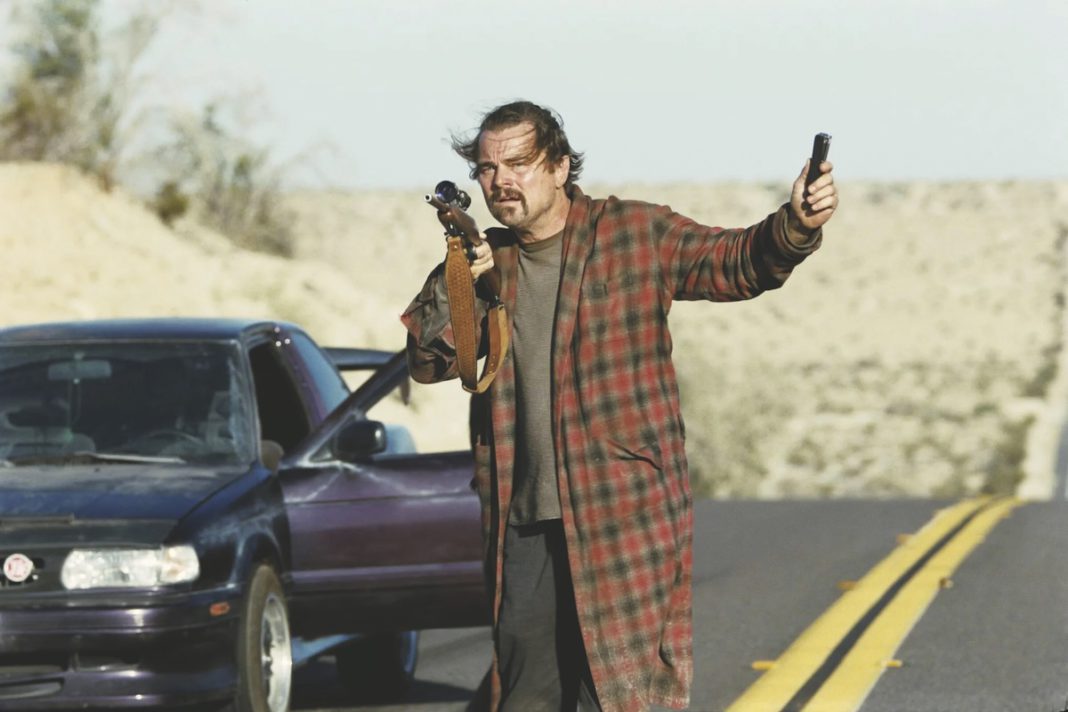
Equal parts Dr. Strangelove, The Battle of Algiers and Paper Moon, the film follows Leonardo DiCaprio as “Ghetto” Pat Calhoun, an explosives expert and member of the French 75, a revolutionary group that we meet rescuing immigrants from a detention center in Southern California. He falls in love with Perfidia Beverly Hills, played by the incendiary Teyana Taylor, and has a daughter, Charlene. On the run from the U.S. government—personified by Sean Penn’s profoundly disturbed Col. Steven Lockjaw—Pat just wants to keep his little girl safe while being true to his own subversive spirit.
One Battle After Another is also ridiculously funny and twitchily intense—an unreservedly entertaining ride that pulls the audience along through its twists and turns in such a propulsive way as to make it feel just as revolutionary as the French 75.
Beneath the expertly calibrated performances by DiCaprio, Penn and Benicio del Toro, and beneath the brilliant madcap satire designed to stir the hearts and minds of its viewers, what Anderson really achieves with this film is to say, unequivocally, that the most American thing a person can do is to be a revolutionary. Not necessarily by the strictest definition of the terms, but by living life in a way that fosters connection, beauty and love.
As much as One Battle After Another rallies against injustice, racism and a police state, it pushes its viewers toward just being better humans and more engaged members of our community, while leading with love instead of fear.
Aside from Anderson’s stunning script and direction, we’re also blessed with career-best compositional work by Radiohead’s Jonny Greenwood, understated and lush cinematography by Michael Bauman, and star-making performances from Taylor and Chase Infiniti. Every detail is executed flawlessly in a way that most movies don’t even come close to achieving, making One Battle After Another feel momentous even as we watch it, but without crystallizing as to why until after it’s over. It’s perfect. An actual, perfect film. One of the very few.
What’s also slyly and brilliantly subversive is that One Battle After Another isn’t just set in Trump’s America. By letting the technology look somewhat dated in the service of a story that feels immediate, One Battle After Another becomes unstuck in time. It’s a rallying cry for the past, the present and the future that won’t feel like an artifact when people marvel at its prescience 100 years from now. Anderson isn’t telling people to wake up right now; he’s telling the entire world to pay attention to the collective mistakes of our past so we’re not chalking off the outline of the ruins in our future.
One Battle After Another will be taught in film classes decades from now when instructors want to illuminate the inherent power of cinema in the hands of a visionary. I hope the shaggy odyssey of this story helps empower generations of Americans to push back against the dehumanizing othering being weaponized into turning a country of immigrants into something far less utopian than dystopian.
Whatever the eventual legacy of this movie is, it’s unlikely there will be a more entertaining or important film in 2025. Movies like this are why I champion cinema as an art form and have dedicated a big part of my life to writing about them. It’s a mirror and a window. What do you see?