A collection at Mills College Art Museum has long flown under the radar of most people in the Bay Area. To celebrate the museum’s centennial, the “100 Years of Creative Visions” exhibit and related public programming bring forth a cross-cultural selection.
On view from Sept. 13, 2025, to April 2026, the exhibit presents an opportunity to see Asian textiles, ceramics and wood-block prints, as well as art by contemporary California Impressionist painters, Group f/64 Modernist photographers, Mexican Modernists, contemporary European artists and others whose work reflects German Expressionist and Bauhaus traditions.
Stephanie Hanor, the museum’s director since 2009, says the museum’s holdings have been driven by a collection of local and far-flung artists working in collaborative communities in the Bay Area. Support from the institution’s key founder, Albert M. Bender, and subsequent directors expanded the collection. “These folks knew each other, pushed each other, experimented together,” Hanor says.
The artists often drew from each other’s work. Hanor suggests that as their creativity multiplied and boundaries between genres dissolved, the museum became a key partner in the development of artistic ideas in the 20th century. The 12,000-plus artworks are a testimony to the museum having created a vast network of artists.
“It’s not a generic collection of greatest hits of American and European art,” Hanor says. “What I wanted this exhibition to do was tell the story of the museum. It’s about this location, the relationships, the directors who’ve shaped it. These connections were what I focused on; with artwork spanning from 3,000 B.C. to the present. It tells of the relationships the museum’s built with artists over time, and the movements influenced.”
The museum is relatively well-known for its California Impressionist artwork, less so for its holdings in Mexican and European Modernism. The artist-in-residence program brought Latino, Bauhaus and other international artists to the campus. “They would teach for a summer, show their work here,” Hanor says.
Highlighting in conversation four specific works, Hanor notes Imogen Cunningham’s gelatin silver print of Helene Mayer that the American photographer made while working on campus as the official photographer. The striking image of Mayer, a German-born athlete who immigrated to California, is close-cropped. A foil blade positioned in front of her face “slices” the portrait in half.
“It’s a powerful, simple image,” Hanor says. “It’s also the story behind Mayer, who was Jewish and went back to Berlin to compete as a German in the 1936 Olympics. It was a complicated time, when Germany was only allowed to host the Olympics if they agreed to allow (German) Jewish athletes to be involved.”
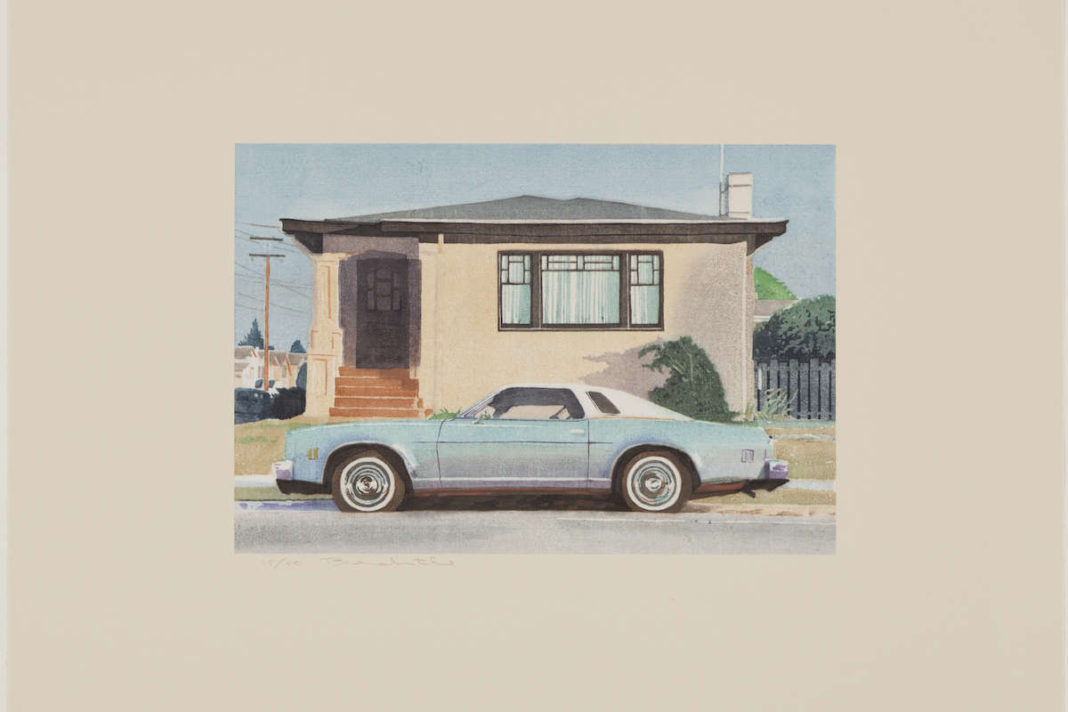
Other stories told through art convey personal narratives. Robert Alan Bechtle’s “Albany Monte Carlo” (1990) prompts Hanor to say, “The banality of the image is so clearly San Francisco, Northern California. It’s part of mid-century World War II Bay Area artists who were interested in figurative work. It’s very much against the abstract painting that was happening in New York. Bechtle was interested in precise presentations of everyday objects and experiences that documented his life.”
Winslow Homer’s “Waiting For Dad (Longing),” shows a young boy perched on an upturned wooden fishing vessel, gazing at sailboats. “There’s a sense of nostalgia, the imagery harkens back to an age that was freer than today. There’s a softness to the watercolor that has a kind of sweetness. It’s also indicative of Maine, where Homer was working—and Northeastern whaling that held dangers. Interestingly, it came into the collection by way of Jane Tolman, the sister of Susan Mills, the college’s founder,” Hanor says.
Among other not-to-miss pieces—remarkably, all under one roof—are works by Ruth Bernhard, O.M. France Viana, John Gutmann, René Magritte, Mildred Howard, Faith Ringgold, Henri Matisse, Anne M. Brewer, Nancy Selvin and Antonio Sotomayor. With MCAM’s centennial exhibition, remaining “invisible” is likely no longer an option.