
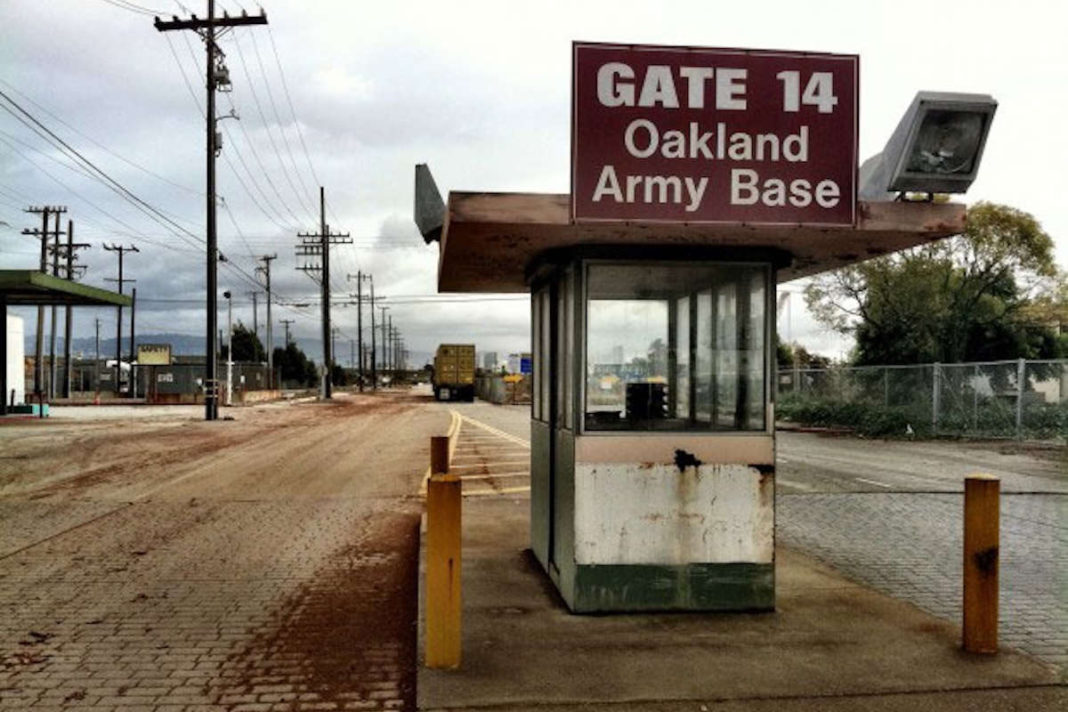
As the County of Alameda continues a much-prolonged process toward redevelopment of the Coliseum, a process expedited earlier in July when the board of supervisors voted to sell the county’s 50% ownership of the property to the African American Sports and Entertainment Group (AASEG), a redevelopment model that began emerging 25 years ago is receiving renewed attention.
When the Oakland Army Base was finally fully decommissioned in 1999, the 425-acre “city-within-a-city” sprawling from West Oakland to the Bay lost good-paying jobs, housing, stores, bars and restaurants, community centers and other resources. Andrew Jaeger, author of the study “When Labor & Community Come Together: Lessons from the Oakland Army Base Redevelopment” (UC Berkeley Labor Center, May 2025), described bases such as OAB as “self-contained communities…[the] OAB community integrated with Oakland, particularly adjacent West Oakland, since the base employed many local residents. The base was also relatively open to civilian non-employees; there are stories of children from West Oakland playing there and dance nights open to the public.”
West Oakland residents wanted a voice in what would happen as redevelopment plans were proposed. Enter the East Bay Alliance for a Sustainable Economy (EBASE), which helped form the Revive Oakland! labor/community coalition. The coalition led the fight for a community benefits agreement (CBA), which eventually shaped the billion-dollar redevelopment of the former base.
Revive Oakland! integrated the interests of 30 organizations, said EBASE Executive Director Kate O’Hara, including “labor, youth, faith, local community organizations … which shared common interests” in seeing any redevelopment include good quality jobs. “OAB was a thriving hub of jobs and other services,” she said, and community members, having endured a painful period of deindustrialization, did not want “market forces” to be the driving determining factor in the site’s future.
States Jaeger’s study: “Between 1954 and 1985, the city lost over 20,000 industrial jobs, with West Oakland and Black communities bearing the heaviest burden.”
Beginning in 2007 and continuing through 2017, Revive Oakland! led two campaigns to ensure the former-OAB’s now-owners used community input before any redevelopment took place. The first effort, from 2007-2012, concerned the city-owned site developed by Prologis and California Capital and Investment Group; the second, from 2015-2017, targeted the section owned by the Port of Oakland, according to Jaeger’s study. “Both campaigns proved remarkably successful in achieving their demands,” the study states.
Jaeger explained further in an email: “The key success factors were Oakland’s long history of community and worker organizing, which had established networks of trust between coalition members and allies in local government; the institutional resources provided by lead organizations, especially EBASE and the Alameda Building Trades; and the coalition’s compelling message emphasizing the broad benefits of providing good jobs for all.”
EBASE provided crucial full-time organizers, researchers and other support for Revive Oakland!’s multi-pronged community organization efforts, which included door-to-door outreach to residents, town halls at neighborhood churches about the need for good jobs, demanding that city officials commit to supporting an agreement about jobs and large-scale events, such as the Urban Peace Movement’s youth concert and rally in front of Oakland City Hall.
Another important EBASE contribution, the study points out, was its connection with PowerSwitch Action (PSA) and its Community Benefits Law Center. The CBA Revive Oakland! used as a template was provided by PSA, and this “wealth of experience proved invaluable during challenging negotiations, such as when the project developer initially refused direct dialogue with community groups.”
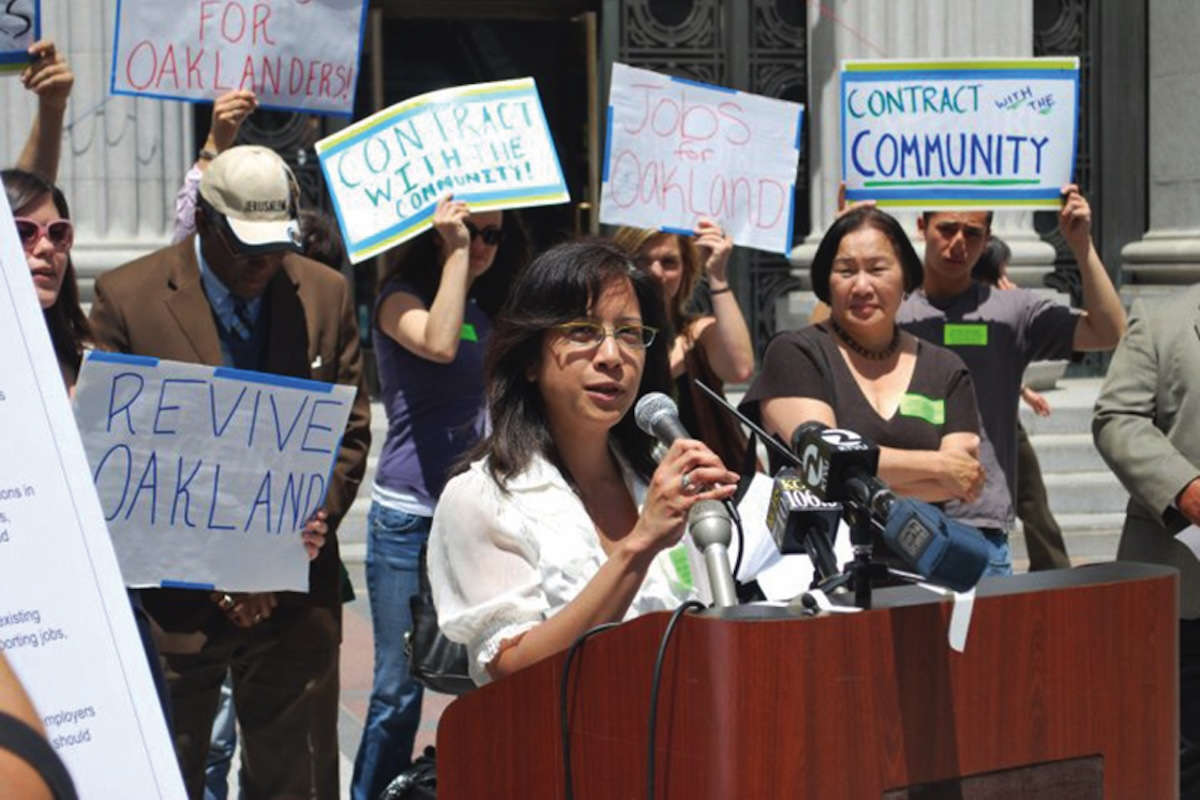
Ultimately the Revive Oakland! coalition successfully secured commitments for a living wage for all workers, a 50% local area target for construction and long-term operations work, a 20% apprentice target for construction work, a 25% “disadvantaged” worker target for apprentices and operations jobs, restrictions on the use of temporary workers for warehouse jobs, anti-discrimination fair chance hiring policies and use of an independent employment agency to facilitate local hire success (the West Oakland Job Resource Center). (Source: Jaeger study)
That Revive Oakland!’s efforts made a difference in the lives of local residents is exemplified in the story of Sadakao Whittington. Incarcerated for 17 years for armed robbery in Solano State Prison and released in 2014, he knew finding work would be difficult.
But he had already made up his mind to turn his life around and when he walked into the West Oakland Job Resource Center, he was prepared. “A county worker came in and asked, ‘How can I help you?’” Whittington said. With the center’s help, he passed his job requirements test and got a job in demolition.
“I was the last to be hired—and the last to leave,” he said.
Today Whittington, a respected member of the Sprinkler Fitters Local 483, is about to be certified as an instructor. Working his way up in the trades wasn’t easy. “I didn’t know how to [correctly] read a measuring tape. I had to YouTube it!” he said, chuckling. But putting on his boots, safety vest and hard hat “changed the way people look at me. Ability is nothing without opportunity.”
Whittington credits EBASE for “laying the groundwork” to give him and other West Oakland residents access to good jobs. Although he’d never heard of a CBA in 2014, today he understands how income from those jobs impacts the entire community. “EBASE is like a lighthouse for impoverished communities,” he said.
Now, as Oakland and Alameda County move forward on Coliseum plans, EBASE’s O’Hara said the successes at the former OAB can be replicated. “A Community Benefits Agreement is a central piece,” she said. In fact, she said, “The OAB victory set a national precedent.”
The multi-billion-dollar redevelopment AASEG concept “would create 20 times the number of jobs that OAB has,” Whittington said.
As for the study, “There’s growing interest in using project labor and [CBAs] to create good jobs and ensure private development yields public benefits. These are among the most effective tools available in the current climate…this study will be useful to anyone interested in leveraging these tools—workers, policymakers, community and labor organizers, and political leaders,” Jaeger said.