
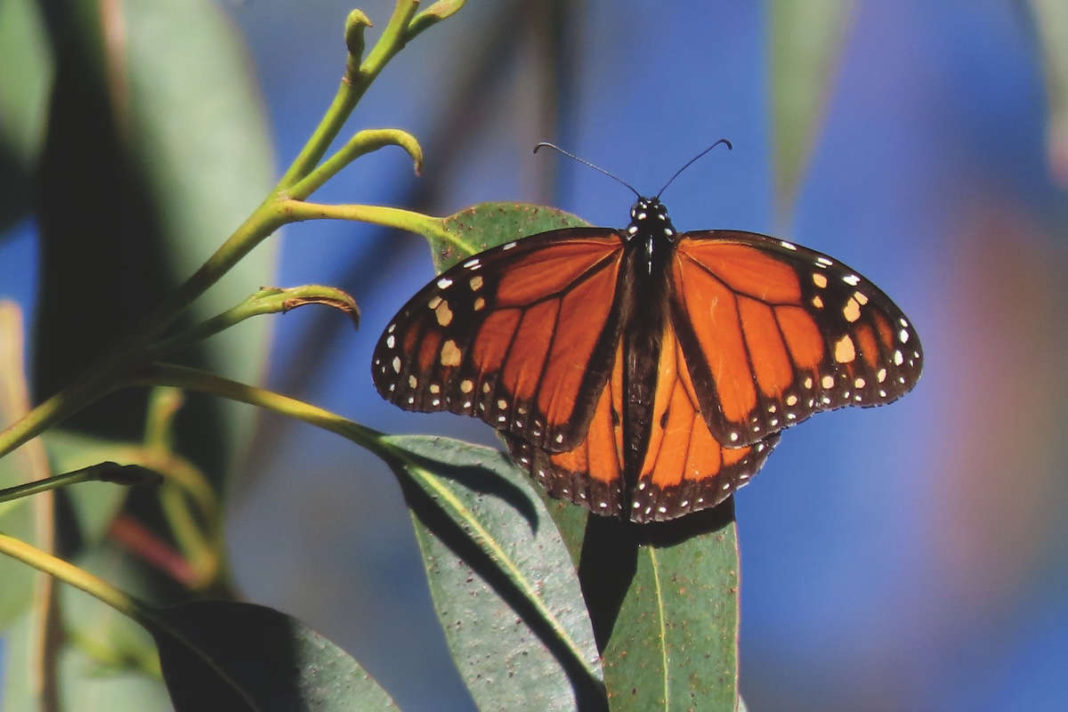
Alongside the endangered redwood, the monarch butterfly is a symbol of our land.
We have taken the monarch as our emblem—one sees it in many places—on our T-shirts and jewelry, our journals and our sky-flying kites. It is on our place-making murals of fluttering monarchs and happy people. The monarch floats up from our subconscious and haunts our dreams …
Little wonder then that the annual migration of the western monarchs, flying up the coast from Mexico, is one of the great natural wonders of the West Coast.
Or, I should say, it was.
As I write, at the height of fall harvest, we are at the height of the monarch migration. Let me ask our readers—trash consumerism aside, has anyone seen a single, solitary one?
Although it goes little reported, in the last 10 years the monarch population has collapsed, from a degraded and declining baseline of several million in the 1990s to just 9,000 this last year. (See The Xerces Society for Invertebrate Conservation’s paper, Western Monarch Declines to Near Record Low, 2025.)
That means if one has been so lucky—so blessed—to see one monarch this year, in 1995 they would have seen 200 monarch butterflies floating through our skies. If they have seen 10, they would have seen 2,000 monarchs—can one imagine such a prodigy? Most likely one has seen zero. Our hazy, blue-and-brown skies are empty.
Emptier Skies
Poets have called butterflies “nature’s living jewels.” As a general trend, across the United States, butterfly populations are collapsing. (See North American Butterfly Association’s American Butterflies magazine story, “The Great Butterfly Die-Off,” 2025.)
Can one even imagine a world without the play of butterflies? If that thought causes pain, then one is connected to the butterfly and its pain. With its death, something dies in oneself.
It’s not just butterflies that are going extinct. As a generality, most “winged insect” populations are now in a mass die-off. That broad group and segment of life includes butterflies and moths, mosquitos, honey bees, flies, dragonflies, beetles of all stripes, wasps, cicadas, lightning bugs, ladybugs and more.
They are all rapidly disappearing—right here, and all around the world. The rapid decline is so dramatic and distressing that some scientists are calling it “The Insect Apocalypse.” (See Current Biology Magazine, “The Insect Apocalypse and Why it Matters,” 2019.) That’s a striking phrase. It’s a big story. It’s the headline for 2025.
It’s funny we haven’t even heard of it, huh? I haven’t seen any mention of it while endlessly doomscrolling my Instagram Reels. But perhaps some of us have noticed it, if only secondarily—with less need to spray pesticides on our lots or clean smashed bugs off our windshields.
As a class, insects represent a major part of the “biomass” on Earth—that is the weight and the number of life forms on Earth. And they’re rapidly dying away. That might not move us all. When we interact with insects, quite often they are seen as pests and nuisances. “Bugs are gross.” But it should be concerning—insects, as the basis of biomass, are the basis of food chains. Pluck hard on that food web, and it ripples out to shake all living species.
Hurt by the seeming indifference of most people to insects, local butterfly expert John Hibbard—my own father—elaborated on that point: “In the grand scheme of nature, butterflies [and caterpillars] exist to feed birds.”
The elder Hibbard is right: Along with insect populations, bird populations are collapsing all around us. According to a recent report by the North American Bird Conservation Initiative (NABCI), 30% of North American bird species are now in free-fall decline. (See NABCI’s “The State of Birds,” 2025.) Birds are falling, from emptier skies. And silent is the spring (see Rachel Carson’s epochal Silent Spring, 1962). And these deaths are not painless deaths. Mass starvation—the inability to get insect food for themselves and their young—is a cause of their collapse.
Our plants are dying, too. Insects feed animals, and they also pollinate flowering trees and plants—forming a vital link in their reproductive cycle and fruiting. Insect death ripples and rips through the meadows and forests where we seek spiritual refreshment and peace. All the food web is shaking violently, as in a great earthquake, as if in a great storm.
The Holocene Mass Extinction
Reader—fellow human being—we have reached an inflection point, a decision point. And now, it is time to choose. Have no doubt. This is the biggest story of our times. Make no mistake. Trump is just noise, China is noise, Tik Tok trends are noise. Taylor Swift’s wedding is noise, the football season is noise, and Disney-Marvel is a desperate distraction from what is happening here and now.
Stop distracting oneself. Undeceive oneself. Put the pieces together. Endangered apes and elephants in Africa, dead coral reefs in Arabia and Australia, collapsing fisheries, disappearing kelp forests, the slash-and-burn destruction of the Amazon, the endangered honey bee, the last flight of the monarch—these are all pieces of a much bigger story: Global Mass Extinction.
Per The International Union for Conservation of Nature (IUCN), a once-every-four-years gathering of global nature conservation experts, leaders and decision-makers, 28% of all living species are now at risk of extinction. It won’t stop there. (See IUCN’s “Red List.”) That’s trillions of insects, plants and animals sick and starving, unable to propagate or keep their young alive. Mass extinction is the headline for 2025 and 2026 and 2027. And it’s the only story that matters.
Factors & Cause
The surprising thing is, we all already know the factors causing what scientists call the “holocene mass extinction event.” But, with a galvanic thrill, let us review them with renewed urgency.
The leading causes of mass species extinction are development—roadbuilding, land clearing, timber cutting, mining, house building, livestock grazing, monoculture farming and pollution of formerly “undeveloped land”—i.e., animal habitats and ecosystems. Development is driven by bad policy, overpopulation and consumptive consumerism gone mad.
Those are the general factors oppressing all other species. But there is also a specific factor suppressing all insect life and setting off a cascade effect of dropping dominos among the larger animals and plants that depend on them for food or reproduction.
All I can say is that it is a relatively new pesticide in increasing agricultural use. It is a broad-spectrum insect killer and long-lived. In dust suspension it has blown about everywhere, and it is present in most of the inorganic food we eat.
I have been warned by some of my science advisors not to be more specific than that. The corporations that make it would think nothing of breaking me or burning this paper down with smear campaigns and baseless-but-expensive nuisance lawsuits. In fact, that seems to be part of their multibillion-dollar business plan. It’s good business to close newspapers.
But the cause is us. Whether or not we are fully aware of it, we are doing this. We are making this happen with our daily choices. This is the true story of our times, and it is the true meaning of our lives. It is our legacy. Like it or not, gathered around our own good works lie thousands of dead butterflies and bees, and birds and squirrels, lizards, snakes, fish, foxes, otters, coyotes, elk, wolves, bears, eagles and mountain lions. Don’t look away.
And while we have now exceeded the point of irreparable damage to life on Earth and may lose the innocent monarch butterfly, it is in our power to choose again and save other species. Just as we already know the causes, we already know what to do.
But let us revisit those changes with renewed urgency and purpose. Thrill to it.
An Urgent New Environmentalism
A meta-analysis of research published by Science Magazine in 2020 revealed “Declines in Terrestrial But Increases in Freshwater Insect Abundances.” The authors of this scientific paper attributed the turnaround to environmental laws and regulations designed to clean up and protect our waterways. Those very same protections are now being torn up by the Trump administration, which is now opening all federal land to rapacious development.
The first lesson of this story is the powerful effect that good government policy can have on reducing species loss. The second lesson is that, for the present, we can’t count on the government to lead the response to mass extinction. Here, submitted by some of the local naturalists and international scientists that helped inform this article, are priorities for a grassroots campaign to slow mass extinction. They are none of them new. It’s the old green agenda. But it’s urgent.
1. Support candidates with a green agenda.
The green new deal. Stopping the sale of federal land while building new parks and linking existing parks. Fighting climate change and climate denial. Helping farmers transition to organic, pesticide-free farming and subsidizing the purchasing of expensive organic food—health food for all.
2. Support nonprofits that promote environmental conservation.
We can support them with our vote, money or in-kind donations; our volunteer time; or by using Facebook, TikTok and Instagram to boost their message.
3. Buy less—reduce, reuse, repair.
4. Buy local—local production and shipping has a reduced environmental impact.
5. Buy organic food and wine.
6. Buy less meat—start with “Meatless Mondays.”
7. Avoid purchases with high-carbon footprints. If one flies, buy carbon offsets.
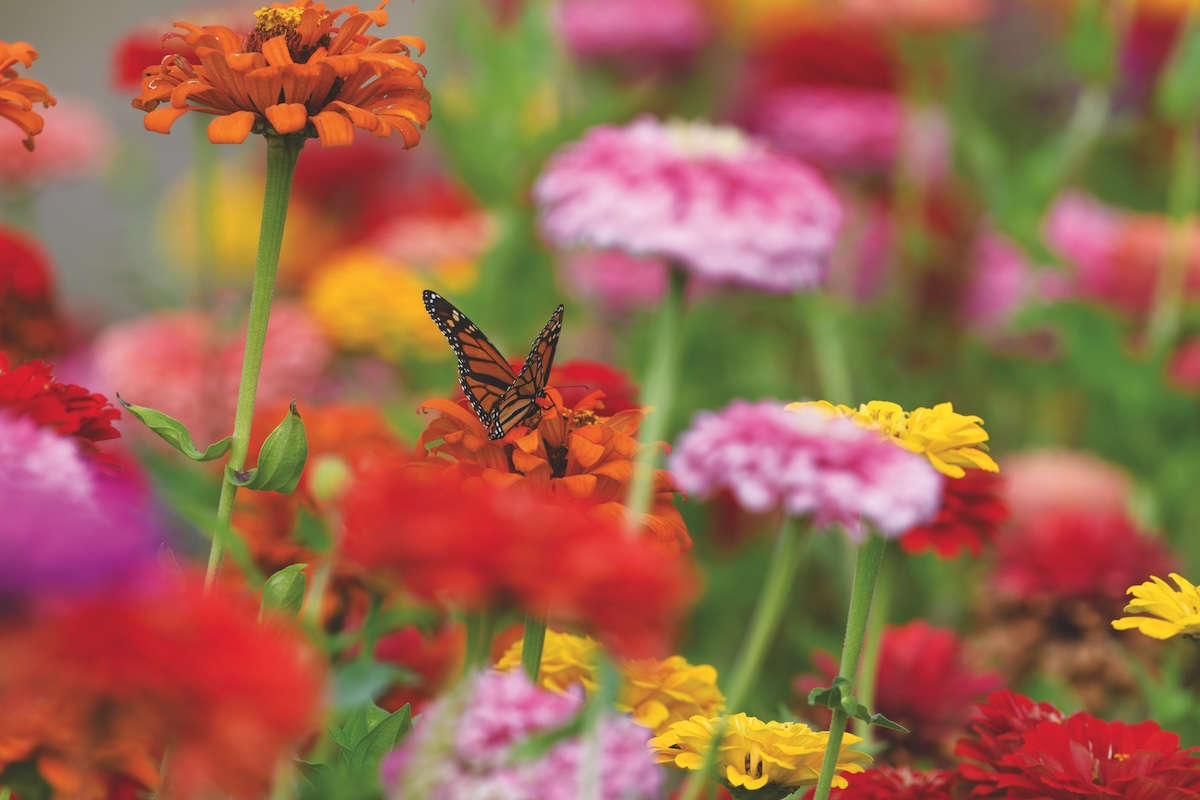
8. Convert part or all of one’s yard or business landscaping to promote pollinator-friendly native plants. Look up “butterfly gardening” and “national park in your backyard.”
9. Spend time connecting with wild nature. It’s good for the body and good for the soul.
10. Talk about these issues with family and friends. Have a conversation about this article. Keep this issue alive on all one’s platforms.
We’ve seen this list before. But now we know we do these things for the bird and the butterfly, the otter and the oak tree. We can’t wait for Washington and Sacramento.
The Humans
Why isn’t mass extinction the story everyone is talking about? Some of the environmental activists, butterfly people, birders and research scientists I spoke to seemed to imply that people just don’t care. “People only care about people,” they said.
But, the fact is, we do care—we are connected to these animals and flowering plants, heart and soul. We love our plants and pets. We love the monarch butterfly. And, whatever people say, humans are fundamentally moral creatures. What proves our morality is how much time and energy we spend distracting ourselves, avoiding a confrontation with the truth.
We fear the truth about our actions because, no matter what we say in public, we don’t actually think we are good people. We know that if we confronted the truth we would be forced to change—by our own fundamentally moral constitutions.
We fear the change, and we fear the reckoning. But we forget how cleansing it can be to make amends, and how lightening it can be to make sacrifices for other living beings. And although we grumble, we forget how adaptive we are. The discomfort of change is brief, and briefly it is forgotten.
Don’t look away. When buying inorganic food or trendy plastic junk, we are buying a dead songbird too. Each time. In time, those purchases add up to a dead bald eagle and a dead grizzly bear. We bought those dead animals. And must pay for them—the cost comes out of our own souls. We are connected. When we buy organics, we literally save lives.
We can change. It is in our power to stop this. And change we must. In this journalistic diatribe I have emphasized what mass extinction will cost our souls—our dreams, symbols, our wonderment, emblems, archetypes, awe, mascots, cartoons, spirit guides, our love, our friends. However, mass extinction may cost us our lives too. For if there is a domino effect, collapsing up the food chain, the last domino to fall will be humans—the apex predator. We cannot simply fence off our corn and our cattle as the environment collapses and burns all around us.
The words of Dr. Joshua Arnold, a scientist who studies the role of beneficial insects in human food agriculture, put it succinctly: “There is a dogma about what we will be able to craft our way out of any problem, but the promises of technology will not be able to make up for a dying planet. Everything we do depends on the ecosystem around us. We might be able to eek on by for a time but we will suffer … Technology won’t save us.”
According to The World Economic Forum and the United Nations Food Summit, pollinating and pest-eating insects are critical to the cultivation of 35% of the world’s food supply (“Why We Need to Give Insects the Role they Deserve in Our Food Systems,” 2021).
With the human population projected to increase by 2 billion by 2050, that projected food shortfall has us fighting a world war. The Insect Apocalypse is the harbinger of a greater slaughter. There still is time to avert it. Let the death of the monarch be our turning point.
Learn more and act: linktr.ee/massextinctionLINKS.