
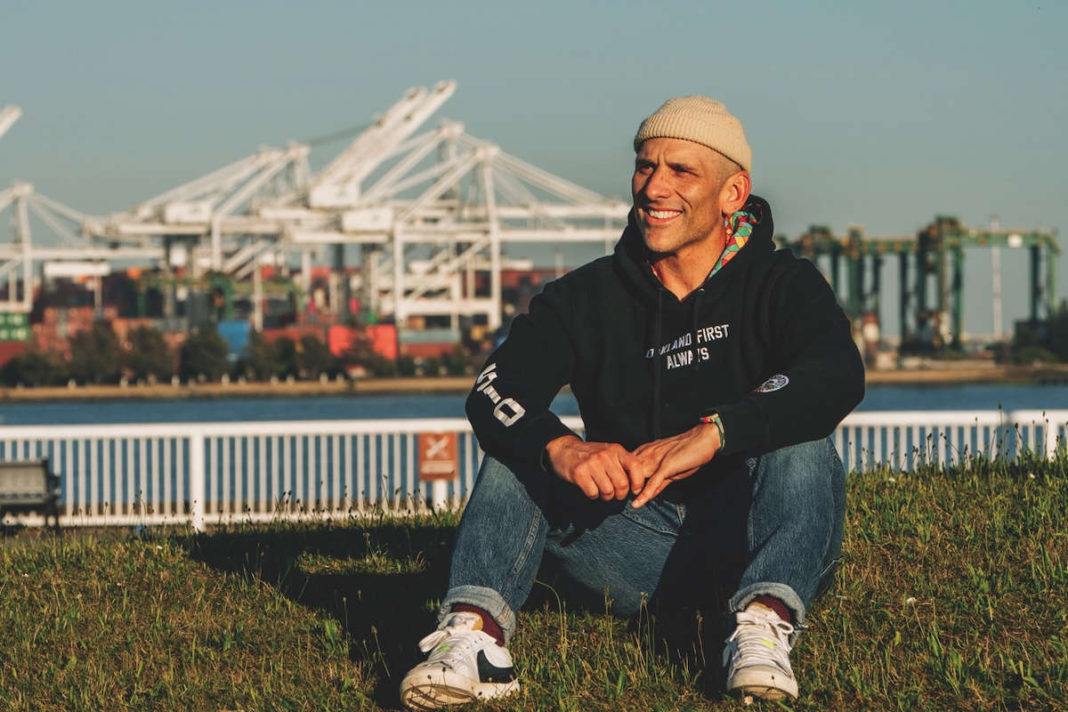
The Port of Oakland stirs before dawn. Cranes rise like steel giants against a fog-stained sky, the air thick with diesel and salt. A container ship groans into a berth, water churning beneath it. Forklifts beep, chains clatter and gulls screech above rumbling trucks whose headlights pierce through the haze. This isn’t just commerce—it’s the steady, unrelenting pulse of global trade.
In The Pacific Circuit: A Globalized Account of the Battle for the Soul of an American City, author and journalist Alexis Madrigal positions the Port of Oakland as a heart of globalization—a key node in the vast network that links Asian manufacturing to American consumption. While the port fuels economic growth, Madrigal shows, it also reveals the human and environmental costs of global capitalism, including displaced dockworkers and fractured working-class communities like West Oakland. Today, residents continue to bear the burden of diesel pollution, truck traffic and related health disparities.
Madrigal presents the port as more than a hub of commerce: It’s a collision point where economic ambition, labor history and environmental injustice converge. These overlapping pressures, he argues, have shaped Oakland’s identity and mirror the broader forces reshaping urban life across the United States.
Born in Mexico City and raised in Washington and California, Madrigal knew early on that he wanted to write. He initially pursued fiction in college, but his enduring interest in the sociopolitical systems that govern people’s lives led him to journalism. He began as a staff writer at Wired and later took on reporting roles at several major outlets before joining KQED, where he now co-hosts Forum, a two-hour, live call-in radio program.
“I wanted to tell real stories about the world,” said Madrigal, who’s lived in Oakland for 14 years and speaks of the city with deep personal reverence. “It’s the only place that’s ever felt like home to me.”
That connection, along with his concern for the inequalities he saw in West Oakland, inspired him to begin writing The Pacific Circuit in 2016. The book explores how international trade and technological change impact labor, housing and health in communities often left out of economic success stories. One of the book’s central figures is Margaret Gordon, an environmental justice activist and founder of the West Oakland Environmental Indicators Project. Her decades-long fight to protect her neighborhood from pollution serves as a powerful throughline in Madrigal’s account, grounding the book’s sweeping analysis in lived experience.
In narrative-rich prose, The Pacific Circuit examines not just policy and economics, but also the everyday realities of families navigating gentrification, displacement and environmental risk. Madrigal’s journalistic rigor is evident, but so is his personal stake in the story. The result is a book that reads as both investigation and deeply informed reflection: A call to reimagine cities that are equitable, sustainable and accountable to the people who live in them.
In 2025, as the Bay Area faces mounting housing pressure, climate threats and the destabilizing effects of automation, Madrigal’s work feels especially urgent. According to the California Housing Partnership, housing costs remain among the highest in the nation, with displacement disproportionately affecting low-income and minority residents. At the same time, labor market analyses from the Brookings Institution and the California Employment Development Department show how automation and tech industry shifts are reshaping job security across the region.
The Pacific Circuit speaks directly to this moment—and to a national reckoning with inequality and urban change. Drawing comparisons to Mike Davis’ City of Quartz and Jane Jacobs’ The Death and Life of Great American Cities, Madrigal’s book sits firmly in the tradition of urban writing that foregrounds structural critique and local resistance. Like Davis, Madrigal dissects the systems that fuel exploitation; like Jacobs, he elevates the stories of grassroots organizers who fight back.
By placing Oakland at the crossroads of global trade and local struggle, The Pacific Circuit doesn’t just chronicle a city in flux, it offers a framework for understanding what equitable urban transformation might look like.
“We don’t really have a good way of analyzing urban change and ensuring outcomes for people who live in our city,” Madrigal said.
Through his book, Madrigal invites readers to consider how progress is defined, who benefits and at what cost.