
It’s easy to be convinced that the YIMBY (Yes In My Backyard) movement has the interests of rent-burdened Californians at heart while the NIMBY (Not In My Backyard) movement doesn’t. In the politicized dichotomy, it’s further implied that YIMBYs are in favor of diverse, inclusive and affordable housing-for-all, while NIMBYs are opposed. In truth, the YIMBY/NIMBY framework lacks nuance and has left the alleged IDHABY (I Don’t Have A Backyard) beneficiaries out of the discussion.
Many IDHABY folks such as renters, couch surfers and unhoused individuals essentially feel abandoned by Gov. Gavin Newsom and the YIMBY movement. In the last election season, Newsom, in the company of California Realtors, the California Apartment Association, California Republicans and many YIMBYs, lobbied hard against Prop. 33, originally called the Justice for Renters Measure.
If Prop. 33 had passed, it would have made it possible for cities to implement rent control. Newsom funded confusing no-on-Prop. 33 ads, including one that featured a single mom who worked her whole life to purchase a home, claiming that the passage of Prop. 33 might have hindered her from adding an ADU rental unit.
YIMBY Action’s website says that the U.S. is 3.85 million dwellings short and that the housing shortage “impacts people of color more because of historic racism.” There is no doubt that people of color have been denied equitable housing access due to the embedded racism and white supremacy. In the early days, housing deeds dictated who could and couldn’t live in particular neighborhoods. Today, the implicit bias of some landlords along with the rising cost of rent dictates it.
Fifty percent of California renters are rent-burdened and spend more than a third of their income on rent, while one third are severely rent-burdened and spend over half their income on rent. Sixty percent of the state’s renters are people of color, and more than half are women.
According to the Gender Equality Perspective on California Housing’s June report, 77% of single moms, 63% of Black women and 65% of women over the age of 65 are rent-burdened. The argument of the YIMBYs is that the IDHABYs can get a backyard because of all of the housing developments that are going up.
YIMBY Action stops short of disclosing that only about 15% of the units in the new high-density housing projects will be characterized as below market rate (BMR) or “affordable.” The BMR units range in price from $225-$700K, and often include large lottery pools for applications. Many low-income renters are hard-pressed to come up with the 3% down payment, let alone the monthly mortgage fees in addition to HOA fees.
While covering housing insecurity during the pandemic and struggling to make ends meet, I learned that my $60K income made me eligible for an affordable rental unit in the East Bay. In 2022, my girls and I made the difficult decision to leave our spacious but rundown two-bedroom apartment for a one-bed-plus-den “affordable unit” a few blocks down the road.
While my salary has held steady, my rent and monthly fees crept up to nearly $2,000 per month, making my affordable unit increasingly unaffordable. The handful of units marked as “affordable” are carpeted and dated compared to the market-rate units. Still, market-rate tenants pay around $4,000 or more for two-bedroom units.
According to the pro-development YIMBYs, families like mine can purchase a place in a new development through the myhousekeys.com platform. That is, if we’re lucky enough to get to the top of the lottery list and we meet all of the qualifications. I was ranked No. 37 in a lottery. To purchase a below-market rate unit for $215,000 with monthly HOA fees of over $500, my finances may put me at the same impasse of others I’ve interviewed who simply didn’t have the down payment or the means to handle rent plus HOA fees.
I’m not alone. Sunita Shastri, a mom of 10- and 13-year-old boys, struggled to find a unit she could afford on her preschool teacher salary and struggled even more to convince a landlord to take a chance on her. She moved into a dilapidated one-bedroom apartment for $1,900/month which had rodents, cracked walls and subpar appliances, leaving her about $200 to cover all other expenses.
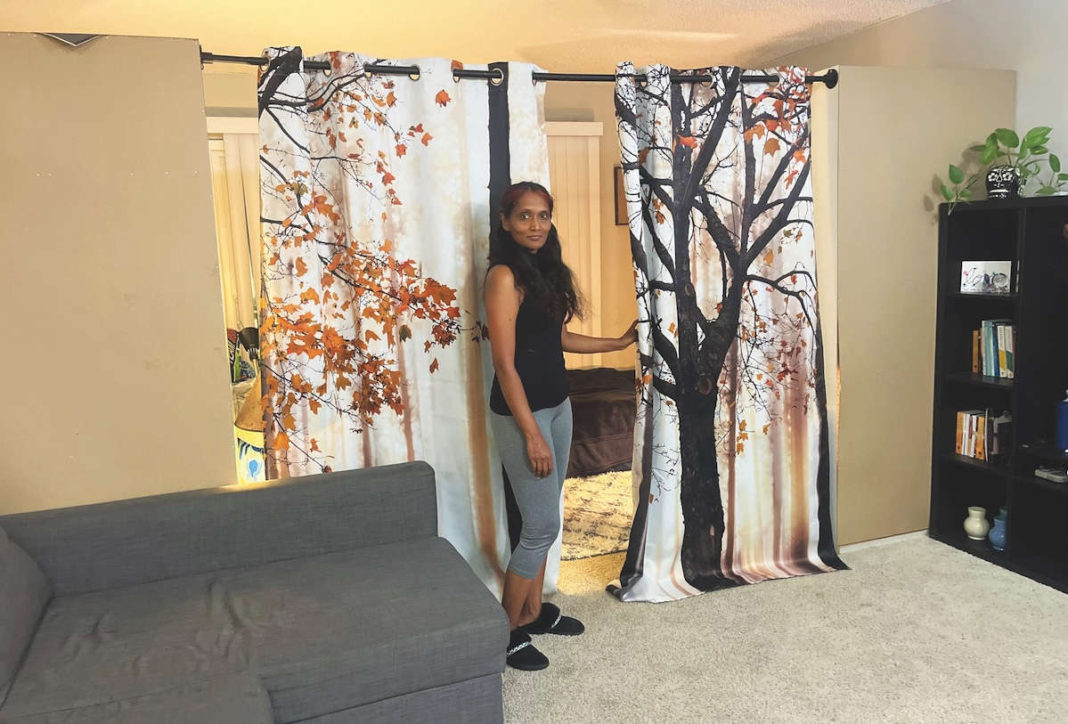
When Shastri checked in with the affordable rental wait list she was on, she was told the list was closed. Ultimately, in 2023 Shastri found a property manager willing to let her get creative. She found a 70-year-old roommate and split her living room into a sitting area with two tiny makeshift bedrooms for her boys.
Shastri fared better than a couple I spoke with who now live at Project Homefulness in Oakland. Previously, they lived in their car and showered at Planet Fitness or took sponge baths in McDonald’s bathrooms after they were evicted during the pandemic for complaining about mold.
We cannot truly address the affordable housing crisis without centering the voices and needs of the IDHABY folks. If we must build millions of new units, is there wiggle room on the percentage and definition of affordable? Why not also stabilize rent so that renters aren’t priced out of their city, county or state?
And when Newsom, California Republicans, realtors, apartment associations and YIMBY align to stop measures with the potential of protecting renter rights, who are they looking out for and who are they leaving behind? If the “haves” are truly interested in creating solutions for the “have nots,” at least invite us to the table and let us weigh in.










Very good article. Some more info on who is really fighting for renters (electeds, tenants unions, pol orgs like DSA, etc. would have been helpful too. Let’s see more of these sorts of pieces. As I recall over 1/2 of CA residents live in rentals.
Thank you so much for your feedback. We’ll definitely do our best to keep housing stories in the mix.
Affordability is a sham. YIMBYs are funded by developers.
Am thankful to Sharon Sobata for her excellent article. We all have to become more active in addressing this in our communities and insisting on viable solutions. Am hoping readers will attend the DEIB gathering on Oct. 8 from 7-8:30 at the Lafayette library. It is way past time to address this.
Hi Sharon – I’d love to connect. We’re a group of citizens in Berkeley trying to get more information on upzoning & housing density that uproots businesses while simultaneously only providing 10-15 % affordable housing