Amidst political backlash, censorship and the denial of gender identities, librarians may be the most undersung heroes of democracy. American filmmaker Kim A. Snyder’s 2025 documentary, The Librarians, shines a light on that.
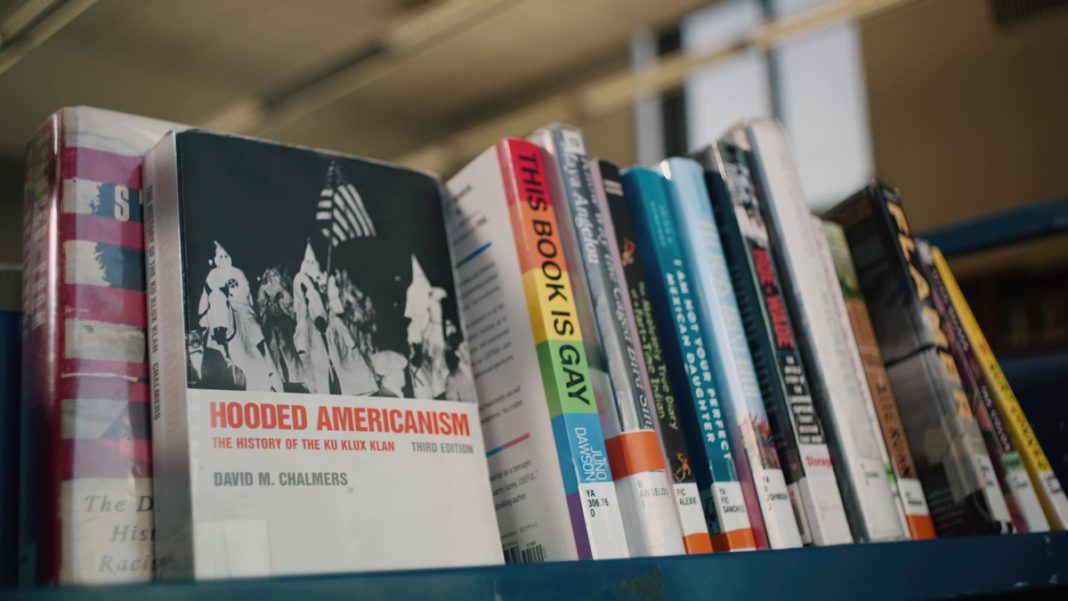
This summer the Department of Defense Education Activity (DoDEA)—schools for the children of military families—banned nearly 600 book titles which collectively address topics like racism, the underbelly of patriarchy and white supremacy, feminism and gender identity, in compliance with Donald Trump’s executive order.
In a separate executive order, the DoDEA was mandated to refrain from promoting “un-American” ideologies, gender ideology or documents that suggest that the founding of the U.S. was racist or sexist. In other words, it was told to eliminate books and curriculum that told the truth about American History.
Since Donald Trump’s second term began, First Amendment rights that were once taken for granted have deteriorated, making it possible for college students who’ve spoken out against the war in Gaza to lose their visas and face deportation. Librarians who highlight books about LGBTQ+ issues or host a drag queen story time also face serious backlash.
What’s it like to be a librarian in this political moment when transgender individuals are being vilified, the racism embedded in American history is being sanitized and the literature that may affirm a teenager’s identity or give them a literary safe place to land is being removed from the shelves? Snyder’s documentary takes on those questions and gives us a taste of just how radical the act of library work has become in this antiwork moment. In preparation for the film’s local arrival next week, we talked with real-life librarians in the East Bay to get the real scoop.
Bill Kolb has worked in Bay Area libraries for the last two decades and has been based at Berkeley Public Library for the past five. The way Kolb sees it, libraries are the most accessible democratic spaces that exist in American society. And librarians are, in a way, not just informants on books and topics but practitioners of radical hospitality.
“Public libraries are one of the last great bastions of democracy in this country,” Kolb says. “There aren’t many places left where anyone—everyone—can go and spend the day without having to pay for or buy anything.”
In a library, people who may not have another place to go can charge their phones, check their email or find a cozy, dry and warm reprieve with a book—without being asked to leave or having the police called on them. On top of that anyone can ask any question and, according to Kolb, be met with not just answers, but cited, vetted, real information.
Kolb says a big part of his job as a librarian is to defend the intellectual freedom of everyone and help the public wade through the overwhelming amount of information, some of which pushes people outside of their comfort zones.
“An informed electorate is powerful. It is also dangerous,” says Kolb, “if you’re the sort of person who would like to tell people what to think or how to live or how to vote. We’re here to sort of hold the line. The library is a place you can go to learn about things that make some folks uncomfortable—maybe even you.”
Kolb finds it heartbreaking to see campaigns to remove books from shelves or to witness librarians facing backlash over public programming they offer.
“[A book being removed from a shelf may] mean that some kid who really needs to see themselves represented in their school library’s collection, or some teen who is struggling with some personal thing that they are too scared or embarrassed to talk to their parents or friends about, ends up missing out on maybe the one thing that could have helped them muddle through,” Kolb says.
Kolb believes there is in fact a win-win scenario that has the potential to satisfy those who want to shelter themselves or their families from information that may make them uncomfortable and those who want to learn and see themselves represented on the page. “If you don’t want your kids to check out books or gain information about certain topics, that’s a conversation for you and your family,” Kolb says. “Don’t presume to answer that question for anyone else.”
Kolb says that working in Berkeley puts him in a utopian hub where he’s far less likely to endure the backlash that colleagues in other parts of the country face. On the other hand, even Berkeley has to be well prepared to face the pervasive transphobia that runs rampantly across the country before certain programs.
“Every time we schedule a drag-queen story time, we have to build out a contingency plan just in case the Proud Boys show up,” Kolb says. “We’ve also had to adjust our reconsideration policy so that folks in other states can’t bombard us with email requests to remove content from our collections.”
Allegra Porter works in the Contra Costa County library system and is currently at the Clayton branch. Porter hasn’t encountered the Proud Boys, but she knows what it’s like to have protesters show up to oppose drag queen storytime when she and her colleagues have offered it. Still, she says, it’s worth it.
“I’m thrilled when we can celebrate reading through the glamorous art of drag,” Porter says. “It’s about representation and introducing kids to someone they might not have met before.”
Porter hopes that kids who don’t see themselves represented in the library can see themselves in storytime and even performances. When she learned about potential library boycotts of the programming, Porter felt a little disheartened. “I hope they change their minds,” Porter said. “Libraries are for everyone.”
Robyn Sweet feels lucky to serve as the teen librarian in the North Berkeley branch of the public library—not in spite of the diversity of topics and people she works with, but because of them.
“All day long, I get to interact with people who are different from me,” says Sweet, “whether it’s their politics, where they grew up, what holidays they celebrate or what their family looks like. You might be surprised by how much you have in common with someone you would otherwise never interact with.”
In listening to the teens and the parents she serves, Sweet says it’s her job as a librarian to meet them where they’re at. Sweet gets lots of requests for books about LGBTQ+ topics, both fiction and nonfiction.
“Teens love to read about characters that mirror their own backgrounds and are going through similar challenges and experiences,” Sweet says. “If you take that away, you are taking away a healthy way to process their own experiences and learn about others who are different from them.”
The way Sweet sees it, differences should be celebrated, not hidden or removed from shelves or stages.
“The fact that we are all different and bring our own unique perspectives is really what makes our community a vibrant and joyful place to live,” Sweet says. “We don’t live in a homogenous world, and it’s important that our stories reflect that.”
‘The Librarians’ screens Dec. 4-5 at Roxie Theater, 3117 16th St., San Francisco. A screening and Q&A session with Kim Snyder at Rialto Elmwood Theater in Berkeley on Dec. 8 is already sold out; on Jan. 15 at 6pm, the theater hosts a benefit screening for the Oakland Literacy Coalition followed by a panel discussion with Oakland teacher-librarians. More info at: thelibrariansfilm.com.



In defiance of community standards, decency, and common sense, these activist librarians are subjecting our children to their personal, ideological viewpoints. This is not defending democracy but is indoctrination. Pure and simple.
I beg to differ. Learning is for everyone.
The presentation of ideas is not saying you should follow that road, only that we are different rather than all the same.
I hope you will open your mind & your heart.