The indelible image of artists starving happily in garrets while living the “La Vie Boheme,” as Rent would have it, has some roots in reality. Many artists, both visual and performing, do struggle to follow their passion while paying the rent. Starving happily … perhaps not.
Since 1986, the Eureka Fellowship Program, established by the Fleishhacker Foundation, has given direct financial support to Bay Area visual artists. Unlike most grant programs, the awards are unrestricted and can be used in whatever ways awardees need to continue creating. The awards are given in cycles, this time around, 2026-28.
Last month, 12 Bay Area artists received the news of the $40,000 grants. Eight of these are East Bay residents. East Bay Express spoke to three of them to find out how the award will impact their lives and work.
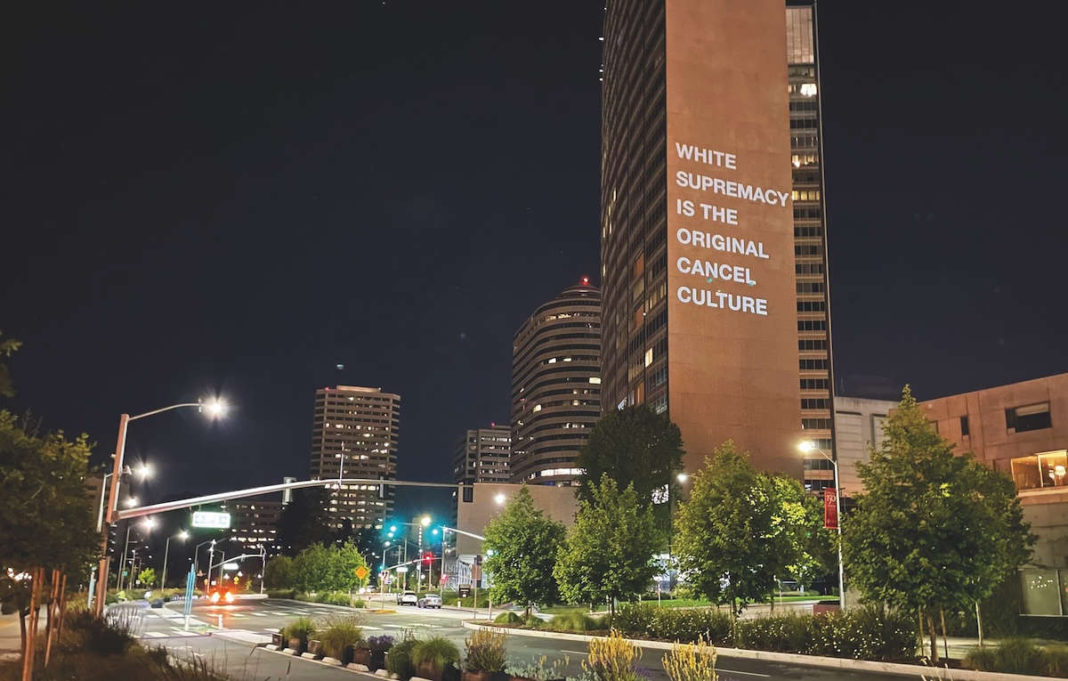
Richmond-based Christy Chan uses video, installation and performance to “question the everyday power structures that uphold white supremacy in the United States.” Her guerrilla public art project, “Dear America,” which projects art works created by Asian Americans onto high-rise buildings, was hatched in response to the wave of violence against Asian-Americans during the Covid pandemic. She will receive her fellowship during the 2028 cycle.
“This is coming at a critical time for artists,” Chan said in a phone interview. “Grants are being cut, and the kind of art is being altered. This gives me a runway to continue taking risks and experimenting … [I can] keep making art even as the political landscape shifts.”
Chan’s fellowship starts in 2028, but she is working on multiple projects now. Her installation “Fainting Couch: Whose Comfort?” is on view at the Di Rosa Art Center in Napa until Jan. 25, 2026, and her short film, Somewhere to Be, premieres at the Hawaii International Film Festival this month, followed by a European premiere in Berlin at the Interfilm – Kuki Film Festival in November.
The film stars an 8-year-old girl from Oakland, and W. Kamau Bell serves as its executive producer. Three Bay Area organizations—including the Berkeley Film Foundation—funded it, Chan said.
“It’s a dark comedy about the interior world of a Chinese-American immigrant family,” she said. “I didn’t plan for this film to come out at this moment, but I am interested in seeing how it can be part of [this moment].”
Chan has always been interested, she said, in showing the experiences of immigrants. She is currently looking for the right location to show the film in the East Bay.
Visit Chan’s website at christychan.com
Nimah Gobir lives in Oakland, and “makes paintings about family, memory and Black identity,” according to her bio. She also creates sculptural pieces. Her parents are immigrants from Nigeria, and she uses photos from her own childhood, layering them with textiles, embroidery and brushwork. In addition to her undergraduate degrees, she has an M.Ed. from Harvard Graduate School of Education with a focus in arts in education.
Gobir received an award in the 2028 cycle as well. “But,” she said in a phone interview, “it is so helpful … I appreciate having the time to plan. It makes me feel more resilient.” Like so many artists, she currently juggles a job while working on her artwork. The award will allow her necessary space for experimentation and process, she said, adding, “I am planning for more time to work on art.”
She’s fascinated by the power and mutability of memory, particularly as it exists in families. Something that happened in the past “can seem like it happened to you,” she said. She uses the boxes and boxes of photos her family took, primarily during the ’70s, ’80s and ’90s, sometimes of just her parents, sometimes of her and her sister, and sorts them into piles as she considers her artworks.
“There are recurring perspectives,” she said. “My mom wearing the same shirt, for example. They form the source material for a painting.” She also collects Nigerian phrases from her parents’ conversations, such as “better dey come,” which in their homeland is a way of expressing both personal encouragement and hope for Nigeria’s future.
“Better Dey Come” is the title of Gobir’s exhibition which just closed at Oakland’s Johansson Projects gallery. “Gobir explores…through lines across generations, finding resonance among her current daily rituals, childhood, and family’s past: braiding hair, sitting for a meal, washing dishes, posing for a group picture. Her mixed-media work collapses time and space, leaving the viewer in a kaleidoscope of memories that diffuse into the present moment,” gallery materials state.
Visit Gobir’s website at nimahgobir.com
Oakland’s Jillian Crochet also received a Eureka Fellowship award. Her work spans sculpture, video and performance “to confront grief and disability.” A wheelchair user, Crochet uses her own experiences to ask, “What is natural/unnatural?” and “What bodies are included/excluded—important?” Her work, she writes in her bio, “reveals the inherent ableism of our built environment and social structures, while seeking to carve out a space for the disabled body to find pleasure and comfort—to liberate the disabled body from normalized marginalization and oppression.”
Reached by phone, Crochet, who will receive her award in the 2026 cycle, said she plans to use the funds to acquire a bigger studio. “[My] sculptures take up a lot of space. And, I will be able to hire fabricators and assistants to realize more ambitious projects,” she said.
Asked about her process in visualizing and creating her art, she said, “I experiment with touch. I have sensory sensitivities. I’m drawn to things that have an intriguing sensorial element, such as rocks on a beach or fabric that’s very soft. And, I’m interested in how vision is prioritized in our culture.”
Her work often references the world’s “built environment,” as opposed to nature. “I pose questions,” she said. Her sculpture Lumpy Bed, currently on view at the Ed Roberts Campus in Berkeley, was inspired both by stress balls and by “the rolling green hills of California,” she said. Viewers are encouraged to lay or sit on the piece.
One work-in-progress is a film about the impractical nature of beach wheelchairs. Her website notes, “Beach wheelchairs loaned by parks require someone to push you, making autonomy impossible. They are hard to maneuver. I will hire a body-builder to push me and document via video and photo.”
Visit Crochet’s website at jilliancrochet.com
Other East Bay artists receiving Eureka Fellowship awards include Jennifer Huang, Sahar Khoury and Rahsaan Thomas, of Oakland; Marlon Mullen, of Rodeo; and Masako Miki, of Berkeley.