
At The Hideout Kitchen & Cafe in Lafayette, chef JB Balingit served hearty American meals. Steak, rack of lamb, fried and roast chicken, and burgers. The food at Tropa, his new restaurant, departs from that long list of familiar classics. When he ventured into the dining room to check in on our table, I asked him why he wanted to make Filipino-inspired dishes at this point in his career. He paused, looked me directly in the eyes and stated matter-of-factly, “It was time.”
Like Nelson German’s celebration of Dominican cuisine at Sobre Mesa and AlaMar, Balingit is embracing his Filipino roots at Tropa. The restaurant’s location is easy to miss. Set back from the street, it’s tucked away in the middle of a strip mall, at The Hideout’s original location off of Mt. Diablo Boulevard. There’s al fresco dining galore and a large wooden spoon that doubles as a front-door handle. The inside is compact but spacious enough for diners to find breathing room between the neighboring tables.
Chef Balingit doesn’t ignore or suppress the colonial influences on Filipino cuisine. The cocktail menu contains a mini-guide of notable, or notorious, figures from the country’s past. He mentioned dishes on the menu that had been inspired by both the Spanish and the Chinese. A plate of pancit bihon ($18) looked and tasted like a version of chow mein with a mix of carrots, peas, cabbage, rice and soba noodles. It’s one of three vegetarian-ish dishes on the menu—only the presence of an umami fish sauce disqualified it.
Everyone at our table was taken with both starters—a platter of chicken lumpia ($15) and plantains ($8). The ingredients in the lumpia tasted impossibly fresh and light after their time in the fryer. I don’t often seek out plantains. Restaurants often under- or over-cook them, achieving either a bitter aftertaste or an unpleasant mushy texture. Neither was the case at Tropa. I ate my slice in its entirety, but was skeptical while doing so. I suspected it was really just a banana, sweetened up with the right amount of heat, time and attention.
A kare-kare stew ($28), made with a savory crushed peanut sauce, included braised oxtail and okra. The chef described the texture of oxtail as “gelatinous.” From his point of view, this was a good thing. Pairing it with okra, which holds its own when it comes to gooeyness, is a bold statement for a kitchen to make. A bowl of steamed rice accompanied it to sop up the sauce, the goo and the gelatinous qualities of the oxtail.
The second vegetarian dish we tried was pinakbet ($20), another stew. This milder sauce featured ginger and coconut milk, which complemented rather than drowned out the pieces of pumpkin, eggplant and bitter melon.
Greedy looks appeared in our eyes after the first few bites of a shared order of inasal ($24), a grilled-chicken entree. The rub was truly irresistible, made with spicy vinegar and calamansi. When someone staked an early claim on the bird, to take it home for leftovers, tensions momentarily increased. Share and share alike went by the wayside because of this delicious dish.
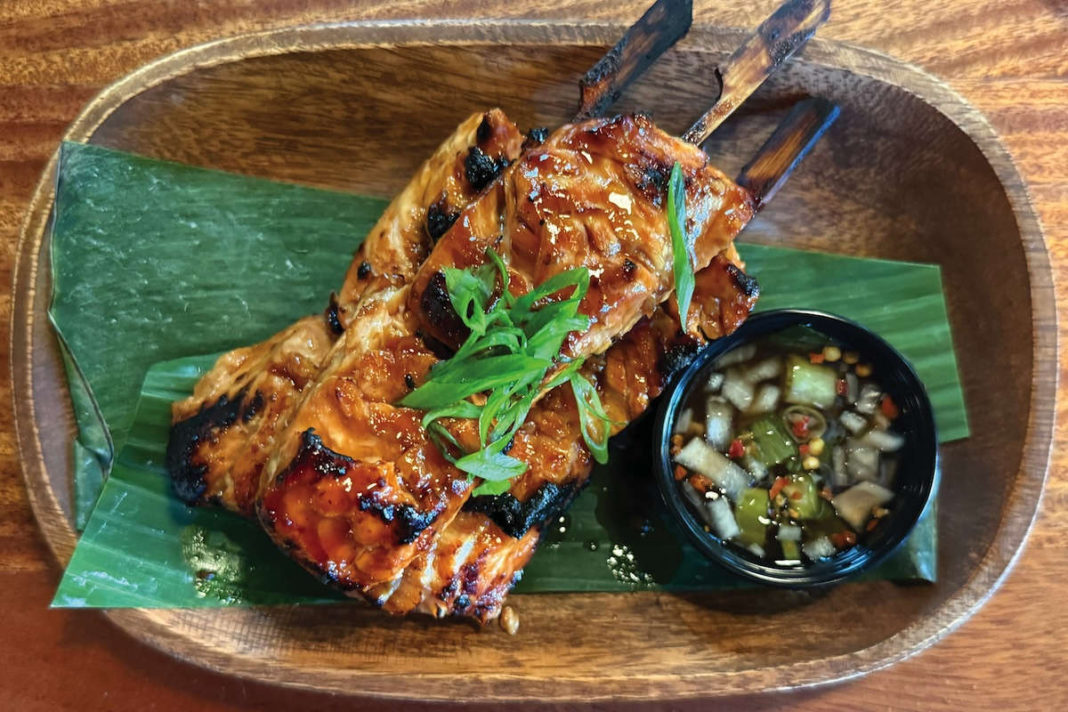
Our good senses returned when the chef brought out two Pinoy street-style barbecued skewers ($18), one salmon belly and one chicken. The marinade must have had soy and possibly fish sauce in it though the menu didn’t specify the ingredients.
To end the meal, the chef brought an entire deep-fried sole to the table. Every part of it, from the fins to the belly to the gills, was sealed inside a golden brown coating. Balingit said that when he goes fishing he prepares his own fresh catches the same way. The tenderest, lushest bites were placed at the center of the plate. The chef suggested that we think of the crispy fins as potato chips. Well, yes and no. The crunch was certainly equivalent. But be prepared for those dorsal bones, only slightly softened by the hot oil fry.
Tropa, 3406 Mt. Diablo Blvd., Lafayette. Open Tue-Thu 5–10pm, Fri-Sat 5pm–Late. 925.900.8861. tropaeats.com