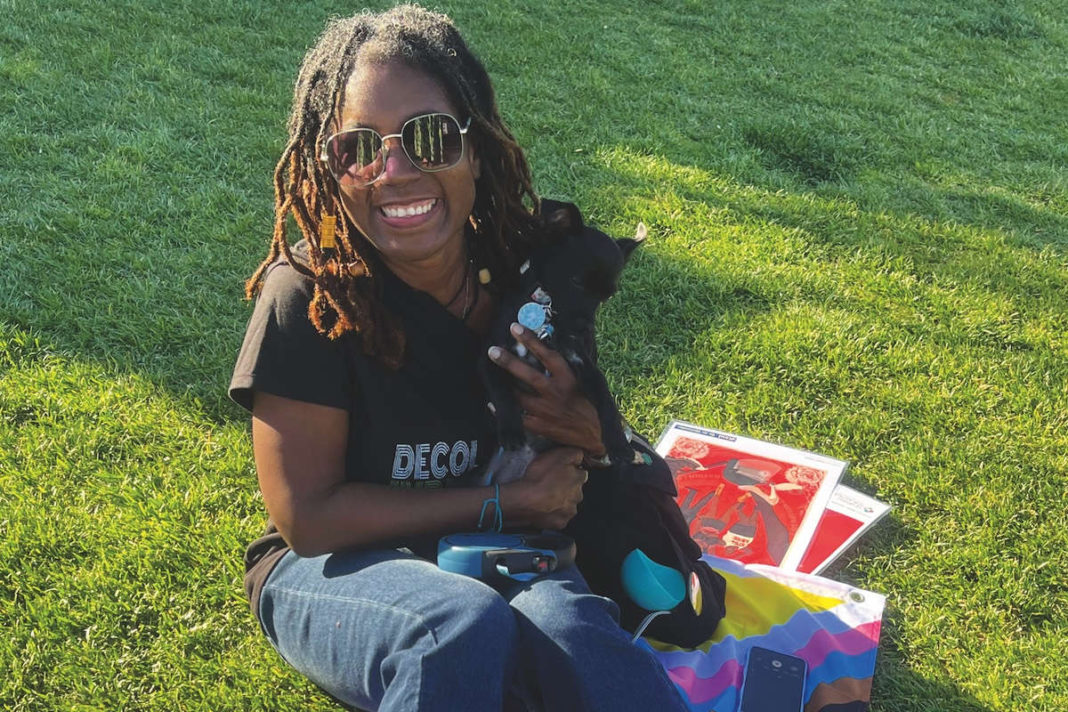
Zahra Ahmed is an activist, a scholar and a mother in Alameda who sometimes imagines herself running for public office. But there’s one thing that always gets in her way.
“I do NOT want to ask anyone for money,” Ahmed says. “And there are a lot of people I know who feel the same way.”
However if the California Fair Elections Act of 2026—a.k.a. SB42—passes, there could be a pathway for more individuals who aren’t wealthy or beholden to corporate donors to put their hats in the ring. If passed, the bill would allow candidates to accept public funds to campaign for office on the condition that they abide by expenditure limits and meet qualifying criteria. District 24 Assemblymember Alex Lee, who helped author the bill, is one of two state legislators who didn’t accept corporate money for his campaign.
“The majority of Americans on both sides of the aisle believe that lobbyists and major donors wield too much influence,” Lee says. “A lot of people would say that Elon Musk wielding so much influence as an unelected billionaire in the White House is a problem. To combat this, we want to empower everyday people to really shape our democracy.”
This can be done through democracy dollars, vouchers or match programs, which Lee says is a way to enable people to be both donors and constituents. Lee points to Los Angeles Mayor Karen Bass, who ran and won the mayoral race using a public funding mechanism, as proof that such a system can work. Passing the California Fair Elections Act of 2026 would mean repealing the Political Reform Act of 1974, which prohibits public officers from spending or candidates from accepting money while seeking elections.
Ahmed believes it’s timely to shine a light on SB42 as Americans prepare to celebrate Juneteenth, the day in 1865 when enslaved people in Texas received word of their freedom. Having people-powered elections, in which people have the capacity to more deeply engage or even run for office, is another form of freedom—particularly for BIPOC communities which have historically been underrepresented in the political realm.
“We sometimes get jaded and aren’t interested in electoral politics because it hasn’t delivered for us,” Ahmed says. “This won’t solve our problems or fix all the social issues, but it does mean that in the political realm a small door will be open.”
Ahmed would like SB42 even more if it required all candidates to use public funding and included restrictions around corporate funding, but says we have to start somewhere. “I would be so happy for my money to be put into this pot to level the playing field instead of having it go towards bombing people and starving them,” she says.
While the playing field is being leveled so that more people can play the game, Ahmed says she hopes this could also be the beginning of people rethinking our two-party structure, so that third-party candidates may also find their way into the race.
“For so long we’ve talked about voting for the lesser of the two evils. We need to change our approach,” Ahmed says. “The two parties really seem to be two sides of one party.”
As the Trump administration cracks down on immigration and begins a massive deportation campaign concerning perceived undocumented immigrants while also banning Diversity, Equity and Inclusion efforts, Ahmed says it’s more important than ever to do what we can to fight back.
“We should not look to the government to validate our history and our celebrations,” she says.
But she also doesn’t think folks should wait for permission.
“As an activist and knowing the nature of this government, I feel like our power lies in coming together as a community regardless,” Ahmed says. “‘Power can be nothing without demand,’ as Fredrick Douglas said.”
Assemblymember Lee might argue that SB42, the Fair Elections Act, has the potential to create the demand via a ballot measure in 2026 to work toward people-powered elections.
“It’s not predisposed to one party or another. It’s just about making sure that there’s more democracy for everyone,” Lee says. “If more democracy means that suddenly everyone is Republican, Democrat or Third Party, then it is what it is. But it needs to be more reflective of the community and less about money.”
Both Assemblymember Lee and Ahmed are optimistic that SB42 will make its way to the November 2026 ballot so that voters can have a bigger say.